Your Self-Hosted Office Suite Is Going Through Some Things Right Now
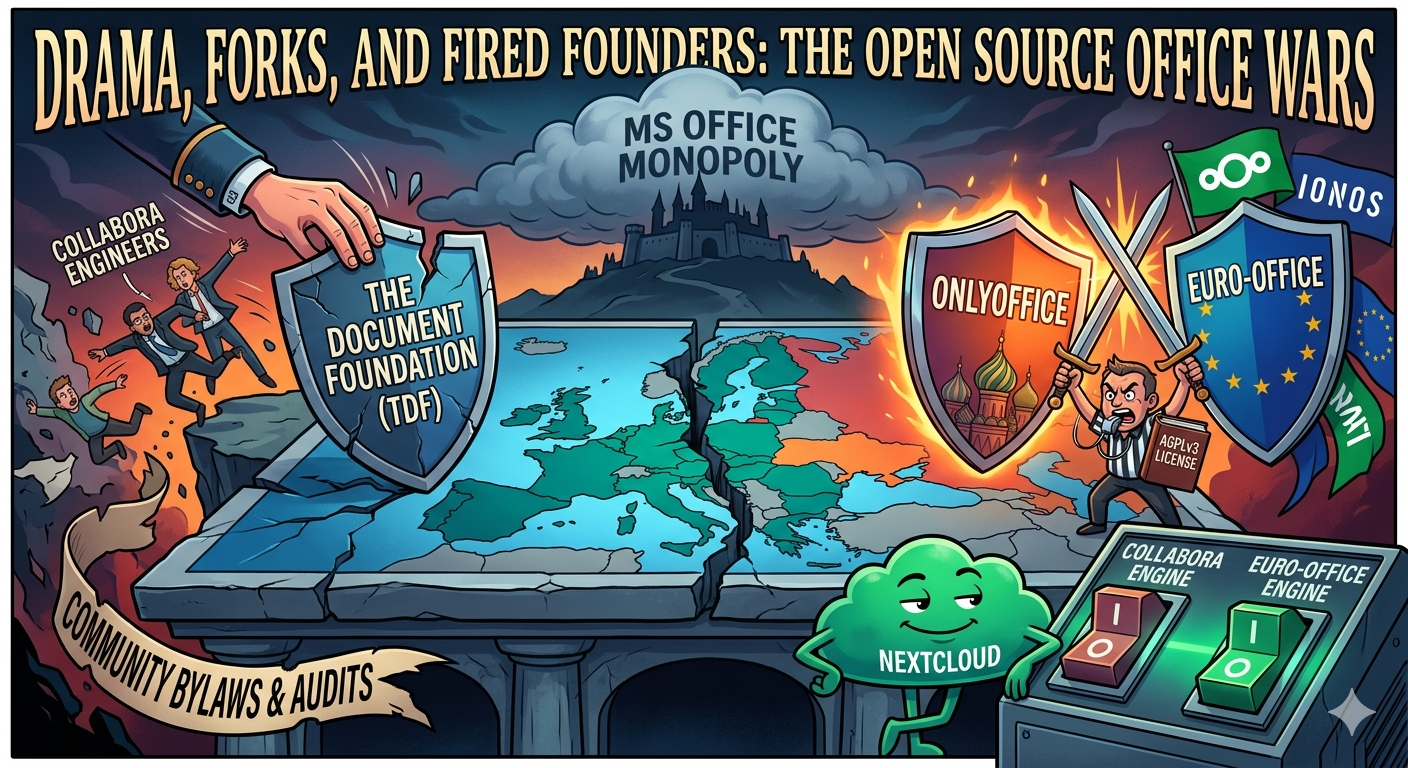
In case you haven't been keeping up with the riveting world of open source self-hosted collaborative office suites, you may want to sit down. If you use LibreOffice, OnlyOffice, Nextcloud, or Collabora, this may be something you want to read all the way through. No parts of this story have been fabricated or exaggerated.
What's the Story Morning Glory?
This spring, a German nonprofit and a UK office software company duked it out publicly, ending in the nonprofit firing its own founders.
Just about everyone agrees the Microsoft Office monopoly needs to end. In just the last two years, a German state, eleven French ministries, and Denmark's digital ministry have all started moving workstations off Microsoft and onto open-source office software, with more lining up behind them. However, there is now Shakespearean levels of drama going on with the plethora of open source options for those people looking to abandon the Microsoft ship.
Fight Card
- The Document Foundation (TDF) — German Stiftung, owns LibreOffice, legally can't tilt the field toward any one company.
- CIB — a Munich document-management firm and the other big commercial LibreOffice contributor whose board ties helped trigger the whole audit mess.
- Collabora — UK shop that does most of the actual LibreOffice engineering and sells the enterprise/online versions.
- OnlyOffice (Ascensio System SIA) — Latvia HQ, slick MS-format fidelity, dual-license model. Strong ties to Russia.
- Nextcloud + IONOS — the platform crowd who forked OnlyOffice into Euro-Office.
Office Contenders

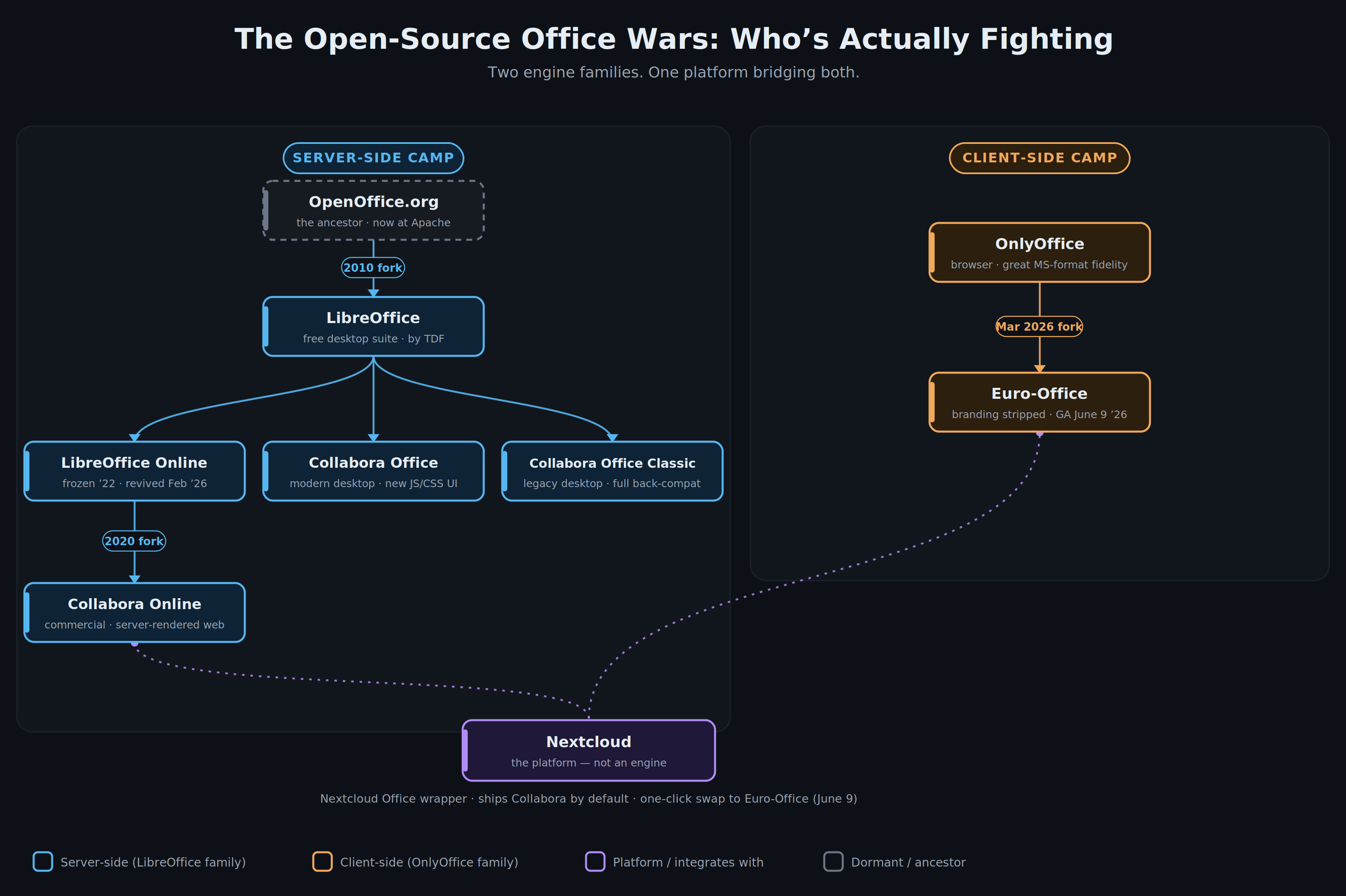
- OpenOffice.org — the ancestor nobody talks about. Sun built it, Oracle bought it, Apache adopted it. It exists mostly so the family tree has a root.
- LibreOffice — the 2010 fork that escaped Oracle. The free desktop suite, run by The Document Foundation. This is the thing the whole war is nominally about.
- LibreOffice Online (LOOL) — TDF's browser version. Frozen in 2022, yanked out of retirement in February 2026 — which turned out to be a match near a gas leak.
- Collabora Online (COOL) — Collabora's 2020 fork of LibreOffice Online. Server-rendered, commercial, and the thing enterprises actually pay for.
- Collabora Office — Collabora's modern desktop build, new JS/CSS interface, legacy cruft stripped out.
- Collabora Office Classic — the old-school desktop build that keeps every legacy feature, for customers allergic to change.
- OnlyOffice — different bloodline entirely. Browser-based, beloved for making Microsoft files actually look like Microsoft files.
- Euro-Office — the March 2026 fork of OnlyOffice by a European consortium, with the branding scrubbed off. (The interesting part of this one is a whole act unto itself — hold tight.)
- Nextcloud — not an office suite at all. It's the platform you run these inside. "Nextcloud Office" just means whichever engine it's wiring up — Collabora by default, Euro-Office one click away as of June 9.
Round 1
The Document Foundation (TDF) is a German charity, which keeps it tax-exempt and lets donors write off their donations. Lose it and you're looking at a roughly 20% tax hit plus a collapse in donations. The catch? A charity legally cannot exist to enrich the companies sitting on its own board.
TDF's board used to consist of people from Collabora and CIB. Those board members voted on things like development contracts and free trademark licenses, some of which happened to benefit Collabora and CIB. As such they were audited 3 times by German regulators.
Now TDF and Collabora are at odds. TDF came out swinging in November of 2025 by drafting new community bylaws with a new addition: any member affiliated with a company in a dispute with TDF has to resign. It went to vote in January 2026 and passed the board. The board which was supposed to have an election back in February. Rumor has it the vote was delayed long enough to get this passed.
Once it passed, thirty Collabora staff and partners — including seven of the ten most prolific LibreOffice contributors of all time — were ousted on April Fool's Day. No joke. Collabora was the single largest contributor to LibreOffice over the previous year: 47 Collabora employees wrote about 43% of the code, versus 8 in-house TDF developers at 37%. TDF, in other words, fired the people writing nearly half its software over guilt by association, with no lawsuit, no hearing, and an election it kept postponing.
Round 2
This round is between OnlyOffice and a coalition of European companies led by Nextcloud and IONOS.
OnlyOffice is the real life Ivan Drago. It's popular because it can render Microsoft file formats and make them look correct. The free Community Edition came with some restrictions: a hard cap of 20 simultaneous connections and mobile web editing locked behind a €950 license fee. It's technically open source software under the AGPLv3, but OnlyOffice added some stuff which is the crux of the fight:
- Section 7(b): if you distribute a modified version, you must keep the OnlyOffice logo in the interface.
- Section 7(e): you are granted no rights to use OnlyOffice's trademarks.
Read together, this legalese translates to "You're legally required to display a logo you're legally forbidden to use. Remove it, you've broken the copyright license. Keep it, you've committed trademark infringement."
To counter this addition, the coalition (Nextcloud, IONOS, Proton, XWiki, OpenProject and a handful of others) forked OnlyOffice in a new product called Euro-Office. Expectedly, OnlyOffice publicly accused Euro-Office of copyright/license violation, suspended its eight-year partnership with Nextcloud, and accused Nextcloud of poaching its staff and going after its customers.
To referee the fight, the Free Software Foundation (FSF) stepped in and said the AGPL doesn't allow for additions like the one OnlyOffice made. Then one of the authors of the AGPL, Bradley Kuhn, backed the FSF.
OnlyOffice responded by stating these findings were just a "later interpretation" which does not count. No, really. While this was happening, OnlyOffice quietly shipped version 9.4, which removed the 20-connection cap entirely and updated its open-source license. The updated license dropped the impossible "you must keep our logo" mandate and replaced it with a normal text-credit requirement, while shoving the no-trademark-rights bit into a separate Trademark Policy.
Intermission
Something worth noting here about OnlyOffice and its Euro-Office fork: Euro-Office was made to establish digital sovereignty; a way for western Europe to rid itself of American tech giants. Except the code it's built on, OnlyOffice, comes from a company, Ascensio System SIA, that's headquartered in Latvia but has deep Russian development roots, and a near-identical twin suite called R7-Office is sold inside Russia by a firm based in Nizhny Novgorod. So the flagship "sovereign European" alternative to Big Tech is, underneath the fresh paint, a fork of software with one foot in Moscow. It's slightly ironic a group fleeing American influence is running right into the arms of Russia, another country which they want nothing to do with. (For what it's worth, the Euro-Office devs have been translating the leftover Russian code comments into English — which tells you everything about where the code came from.)
What's the Difference Anyway?
The big differentiator is where your document lives while you are editing it.
Collabora Online renders on the server. You're essentially looking at a live screenshot of a doc running somewhere else. The upside is real: pixel-perfect WYSIWYG across every format, and the raw file never leaves your server. The downside is also real: it's a hog. You're running a full office engine per session, so RAM and CPU climb fast (budget roughly a couple of cores, a gig of RAM, and ~100 MB per active user), and if your network has any latency, you'll feel it as a lag between hitting a key and seeing the letter appear.
OnlyOffice and Euro-Office render in the browser. The document gets shipped to your machine and your local JavaScript engine does the layout. It feels snappier and your server barely breaks a sweat because it's not rendering anything, just brokering. The trade-offs flip accordingly: the raw file does travel to the client, and while OOXML fidelity is superb (this is OnlyOffice's whole reputation), complex ODF documents can occasionally come out with their formatting slightly rearranged.
And then there's Nextcloud, which doesn't make you choose forever. "Nextcloud Office" is just a slot. For a small setup you can run the built-in CODE server, or for anything serious you run a standalone Collabora container behind a reverse proxy. As of Hub 26 (June 9), you can also flip that slot over to Euro-Office with a single config change, so you can run both engines and let users pick.
And the Winner Is...
Depends who you are.
If you're an OnlyOffice user, you're feeling pretty good that the 20-connection cap is gone as of 9.4. The mobile-editing situation is still murky: the connection limit fell, but mobile web editing is still missing from the free Community build.
If the Russian-roots thing bugs you, Euro-Office is your off-ramp — a cleaned-up, European-stewarded fork with the branding stripped and the worst of the licensing nonsense defused, backed by some serious players (Nextcloud, IONOS, Proton, and friends) who aren't going anywhere.
If you're on LibreOffice or Collabora, the software is fine. It's the governance that's on fire. You'll get a leaner, modern Collabora Office out of the deal, but the foundation behind LibreOffice just alienated the people writing nearly half its code, so keep one eye on how that shakes out.
And if you run Nextcloud, you quietly won the whole thing: you now get to pick your engine with a single click and let everyone else fight about it.
Here's the actual headline, though. A year ago, "open-source office suite" was basically a one-horse race. Today there are multiple independent, genuinely free engines actively trying to out-free each other — and thanks to one very public FSF brawl, a fresh reminder that you can't bolt proprietary handcuffs onto a copyleft license and call it open. You've got more real choices today than you did last spring.
References
- The Document Foundation / Collabora dispute and audits — LWN: Digging into drama at The Document Foundation
- The expulsions and contributor stats — Collabora: TDF ejects its core developers · TDF: LibreOffice State of the Project
- LibreOffice Online revival — TDF: LibreOffice Online, a fresh start
- OnlyOffice's Section 7 terms — OnlyOffice: license-violation claim · Software Freedom Conservancy (Bradley Kuhn)
- Community Edition limits — OnlyOffice Docs Community FAQ (20 connections) · GitHub issue #805 (€950 mobile)
- Euro-Office launch and partnership suspension — Computerworld · Nextcloud press release
- FSF ruling and OnlyOffice rebuttal — LWN: FSF clarifies its stance on AGPLv3 additional terms · Neowin: OnlyOffice invokes AGPLv3
- OnlyOffice Docs 9.4 changes — OnlyOffice blog · IT-Connect
- Russian roots / R7-Office — The Register: Forking frenzy ensues after launch of Euro-Office
- Euro-Office June 9 / Nextcloud Hub 26 — Nextcloud: GA set for June 9 · Neowin
- Government migrations — Tuta: countries ditching Microsoft · TechHQ: France's digital sovereignty migration